

Snow leopard: Around 4,000 remain

Can be found: Asian mountain ranges

Threats: Loss of habitat, human-wildlife conflict, climate change, illegal wildlife trade

Snow Leopard (Panthera uncia)
The elegant and well-camouflaged snow leopard is one of the world’s most elusive cats. Thinly spread across 12 countries in central and south Asia, it’s at home in high, rugged mountain landscapes. But habitat deterioration, loss of prey species, retaliatory killings due to human-wildlife conflict, poaching and climate change are now threatening their survival.
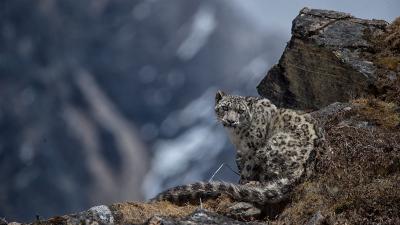
The snow leopard has a beautiful, spotted coat, thick enough to insulate them from the cold. Their wide, fur-covered feet distribute their weight over soft snow.
Snow leopards are solitary creatures, and skilful predators, able to kill prey up to three times their own weight in challenging terrain. It’s been found that poaching and retaliatory killing (as a consequence of a snow leopard killing livestock) are sometimes linked, and the attitudes and support from local communities living in these remote mountain areas are critical to the success of snow leopard conservation.

Why are snow leopards so important?
Snow leopards are top predators in their environment, and their prey include mountain sheep and goats. Without the snow leopard, the ecological balance would be disrupted. For example, herbivore populations would increase, resulting in changes to the vegetation, also affecting other wildlife that live in these areas.
The same mountainous landscape also contributes to human wellbeing, locally and regionally. They provide natural resources upon which millions of people depend in addition to being headwaters for river systems that benefit over 2 billion of the world’s human population. So, by protecting the snow leopard, we’re benefitting the whole natural environment in these areas and the people who rely on it.
Key facts
What is the habitat of a snow leopard?
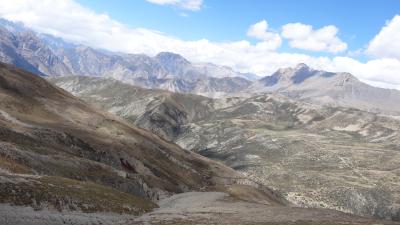
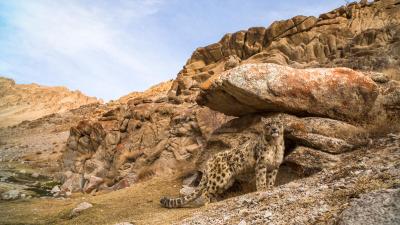
Snow leopards prefer steep, broken terrain like cliffs, rocky outcrops and ravines. They live at high altitudes, usually at elevations of 2,700-5,000m[1] - far higher than any mountain you would find in the UK.
Snow leopards do migrate to lower elevations in winter to escape the deep snow and follow the movements of their prey. They have large ranges - the home range of a snow leopard can vary from 200 to 2,000 sq km[2] - bigger than some UK counties!
Snow leopards are sparsely populated across 12 countries in Central and South Asia[3].
How many snow leopards are left?
There could be as few as 4,000 snow leopards in the wild, however the exact number is unknown as they are extremely elusive[4]. It's estimated that up to 450 snow leopards are killed each year, often in retaliation for preying on livestock, but also for the illegal wildlife trade[3].
There are several more snow leopards in captivity.
How big are snow leopards?
Snow leopards are between 90-115cm long (head to body) and adults weigh between 30-52kg. Their tails are very along - approximately 80-105cm, and are thought to aid balance and provide warmth when they wrap them around themselves[5].
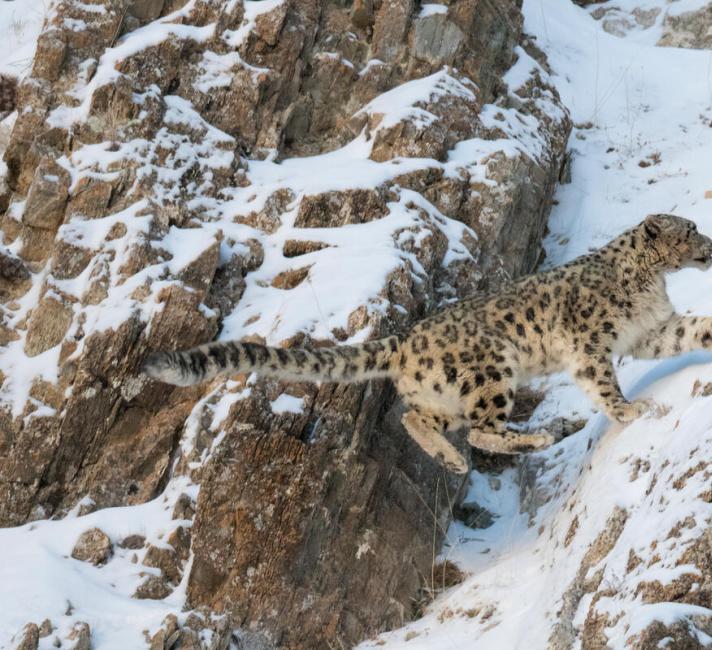
The snow leopards' long hind legs help them leap across steep, rugged terrain[5]. Their fur can be 5cm long on their back and sides and almost 12cm long on their belly[6], as well as having wide, fur covered feet which act as natural snowshoes and protect them from the cold.
Their short, round ears reduce heat loss, and wide, short nasal cavities warm the air before it reaches its lungs[5]. Their tongues have sharp-pointed rasps, called papillae, which are used to scrape the meat off the bones of its prey[7].
While snow leopards have unique rosette patterns like other big cats, their long, thick fur can obscure these markings—making it more difficult to identify individuals from camera trap photos[8].
What do snow leopards eat?
On average, adult snow leopards need up to 2.5kg of meat each day[9].
Their main prey are blue sheep, as well as the ibex and Himalayan tahr (types of wild goat). They also prey on marmot, pika, hares, small rodents and game birds[4]. Snow leopards are opportunistic predators capable of killing prey up to three times their own weight[1]. They usually ambush their prey, but have been observed chasing prey over distances of up to 300m across mountain slopes. Snow leopards need to eat the equivalent of 20-30 blue sheep a year, usually catching one every 10-15 days, and a solitary snow leopard may remain on a kill for up to a week.
What is the IUCN status of snow leopards?
Snow leopards are listed as vulnerable on the IUCN Red List[4] (which is between endangered and near-threatened). This means they face a high risk of extinction in the wild.
How long do snow leopards live?
Where do snow leopards live?
Explore the map below to see the IUCN (International Union for Conservation of Nature) range data for snow leopards.
-
 © WWF-Nepal
 -
 © Naturepl.com Sylvian Cordier
 -
 © Sanjog Rai / WWF-Nepal
 -
 © Naturepl.com / Sandesh Kadur
 -
 © ashley@globalwarmingimages.net

How we're helping
Only 22% of the snow leopards range has been covered by scientific research[3], which is vital to understanding the status of snow leopard populations and their prey species. With your support, we’re helping range states such as Nepal and India with ground-breaking studies to protecting the ‘ghost of the mountain’.
With your support, we’re supporting research and monitoring activities, such as camera traps and satellite collaring, to gain a better understanding of snow leopards and their habitats, which help guide conservation efforts.

Local support
We're working with local herders to promote livestock insurance schemes to help rural communities reduce the financial impact of snow leopard predation by giving them access to compensation for animals lost[15].
We will work with snow leopard range countries to develop science-based landscape management plans that support both conservation and economic development and with relevant government agencies and local communities to engage them in wildlife friendly infrastructure development and land use planning.

Adopt a snow leopard
Adopt a snow leopard
Adopt a snow leopard as a gift for a loved one. Choose between a welcome pack for an adult or a child, and they'll get an exclusive WWF cuddly toy, regular stories about snow leopards, and other goodies!
We also recommend

Go Wild - WWF's Club for Kids

10 facts about snow leopards

Take a snow leopard quiz

World Snow Leopard Day
Sources
- Snow Leopard Trust https://snowleopard.org/snow-leopard-facts/life-cycle/ Accessed 03/12/24
- Science Focus https://www.sciencefocus.com/nature/why-do-cats-have-rough-tongues-but-dogs-dont/ Accessed 17/12/24
- Wemmer and Sunquist (1998) IN khan, B et al. (2014) Pastoralist experience and tolerance of snow leopard, wold and lynx predation in Karakoram Pamir Mountains
- GSLEP https://globalsnowleopard.org/the-snow-leopard/cat-facts/ Accessed 03/12/24
- McCarthy, T., Mallon, D., Jackson, R., Zahler, P. & McCarthy, K. 2017. Panthera uncia. The IUCN Red List of Threatened Species 2017: e.T22732A50664030. https://dx.doi.org/10.2305/IUCN.UK.2017-2.RLTS.T22732A50664030.en. Accessed on 03/12/24
- Snow Leopard Network (2014). Snow Leopard Survival Strategy. Revised 2014 Version Snow Leopard Network, Seattle, Washington, USA
- Snow Leopard Trust https://snowleopard.org/snow-leopard-facts/physical-features/ Accessed 03/12/24
- Wilson DE & Mittermeier RA eds (2009). Handbook of Mammals of the World, Vol 1 Carnivores
- Jackson, R.M. (1996) & Hemmer, H (1972) IN Snow Leopard Network (2014). Snow Leopard Survival Strategy. Revised 2014 Version Snow Leopard Network, Seattle, Washington, USA
- Sharma R. K. and Singh R. 2020. Over 100 Years of Snow Leopard Research: A Spatially Explicit Review of the State of Knowledge in the Snow Leopard Range. WWF, Gland, Switzerland
- McCarthy, T., Murray, K., (Ognev S. I. 1962) referenced in the Snow Leopard Book - McCarthy, T., Mallon, D., & Nyhus, P. J. (Eds.). (2016). Snow leopards. Biodiversity of the world: conservation from genes to landscapes Academic Press is an imprint of Elsevier. and Ognev, S.I., 1962.
- Jackson, R.M. et al. (2006) Estimating Snow Leopard Population Abundance Using Photography and Capture-Recapture Techniques. Wildlife Society Bulletin. 34 (3)
- https://globalsnowleopard.org/the-snow-leopard/threats/illegal-trade/ Accessed 03/12/24
- LINEAR INFRASTRUCTURE IN SNOW LEOPARD LANDSCAPES. 2024. THE GLOBAL SNOW LEOPARD AND ECOSYSTEM PROTECTION PROGRAMME
- WWF-UK 2021. Feeling the Heat: The fate of nature beyond 1.5C of global warming.